

When your queer identity and your cultural identity don't know how to talk to each other
On loyalty, belonging, and the grief of identities pulling you in opposite directions: a post for queer, AAPI, BIPOC, Central Asian, and immigrant adults who are tired of being told both things can be honored.
If you're queer and you come from an Asian American, immigrant, or Central Asian background — Kazakh, Kyrgyz, Uzbek, and other — there's a good chance you know what it feels like to be a slightly different version of yourself depending on the room. The version that shows up at a family dinner and keeps quiet about the person you’re talking to online (or your partner you’ve just celebrated your anniversary with). The version that exists in queer spaces and is tired of explaining your background. The version of you that feels alone, somewhere in between, that doesn't feel like it quite belongs to either. All of those versions of you are real, and they haven't yet found a way to occupy the same space at the same time, and nobody warned you that holding them separately for years has a cost.
It doesn't always look like distress or despair. Sometimes it just looks like a life that is full and real and still, somehow, not entirely yours, somewhat fragmented. It looks like a specific kind of fatigue that arrives after conversations about with your parents. A guardedness in rooms that should feel safe. The habit of subconsciously editing yourself so automatically you've stopped noticing you're doing it. You want someone to see you, really see you, but that is also the scariest thing to imagine: what would it be to have your worlds collide, no longer separate? What if it all falls apart?
Fair warning: this post may tell you what you already may expect it to (both parts of you are true, and let’s learn how to hold them at the same time and teach them how to speak to each other.) But before we get there, let’s acknowledge the grief and the loneliness and the not knowing, and spend a little bit of time with these difficult emotions.
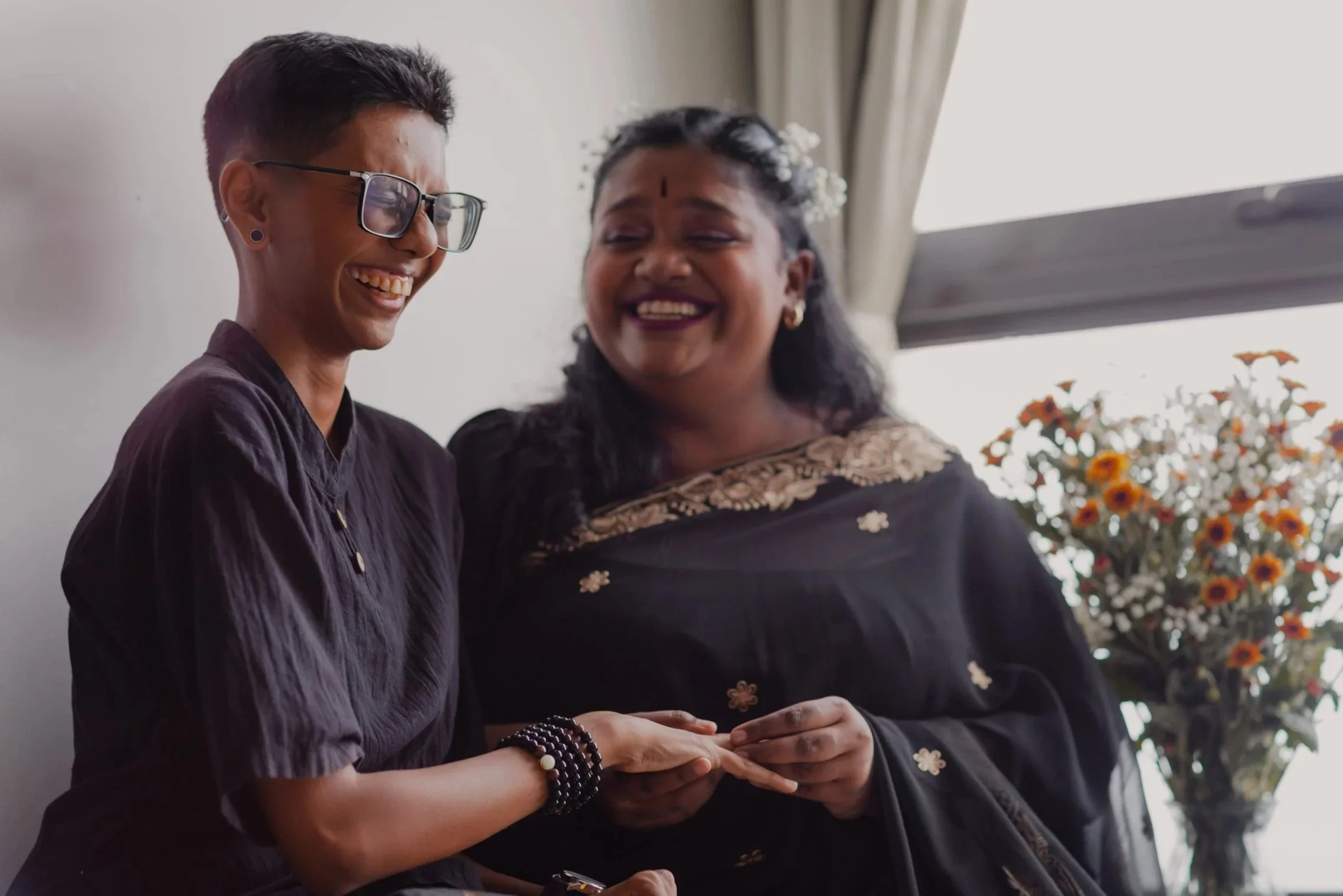
Alongside the genuine love for your family and your culture, there can often be a grief for the parts of yourself that couldn't be show up in those relationships, for the version of you that had to wait at the door. For queer AAPI adults, queer immigrants, and queer first-generation adults navigating identity in NYC, this particular in-between is one of the least talked-about and most exhausting places to live. The work of being queer and deeply rooted in a cultural identity that didn't have a map for queerness is genuinely complicated. Most LGBTQ therapy in New York City wasn't built with your specific circumstances in mind: the model minority myth, the interdependent family system, the post-Soviet silence, the cultural loyalty that coexists with real grief.
This post is for the queer Asian American adult, the queer immigrant, the first-generation adult who loves their culture and is also exhausted by how much of themselves they manage in which room. If you've been searching for a therapist in NYC who understands what it means to hold both, this is a place to start.
A note on my own lived experience: Battling my ancestors
I grew up without seeing a single queer person around me. I knew queer people existed. Mostly through movies with a tragic plot, snide remarks from family members gossiping about someone they knew, the occasional cruel joke. When I came out, navigating the meeting point of my cultural identity and my queer identity felt like forcing two opposing magnets together. I kept telling myself I was doing it, carving out a new place for myself, but it didn't feel like it was working. I felt more alone than ever.
In one training I attended as a therapist earlier in my career, the facilitator invited us to channel a queer ancestor. I spiraled almost immediately, wondering whether any of my ancestors would even be accepting of me, let alone queer themselves. The idea of a world where both were true felt so foreign I couldn't hold it in my imagination. Couple that with a queer scene where my culture was missing, and a real loving family that had no room for queerness, and the ambiguousness of that grief, and I knew something had to change for me to bring the two together within me.
What we usually get told, and why it doesn’t quite land
You know the advice. You must find your own way forward: honor both identities, find community that holds all of you, there is room for so much that you can’t imagine. It is, eventually, the right advice, and the only way forward. But for know, let’s not assume that you are ready to integrate the two, to separate and find your own path just yet. Let’s spend just a little bit more time with this moment in time where you may be still in the part where things feel real and incompatible.
Two kinds of conflict
The external conflict is the one between you and the outside world - your family, your community, your religion. It involves the daily calculations: whether to come out, whether to invite someone in, whether to post the photo knowing an auntie you forgot to block might see it and tell your mom. There are often real safety risks involved, and depending on your situation, it can be dangerous. There can be fears of what could happen to you or to your family if your family found out you are queer before you’re ready, there can be fears about how that might affect your dating life, among many others.
The internal conflict takes place between the queer self and the cultural self. That one is not about family disapproval, but about the part of you that loves your culture, that holds on to memories of your grandmother’s kitchen, the specific kind of humor and personality you possess in another language, that doesn’t want to let go of that which feels like the foundation of who you are. And the part of you that is queer, and that also wants to be fully known, that also wants to be loved and seen and accepted. So how does this conflict show up? Keep reading to find out some possible factors that could be contributing to how you are feeling, as well as some things you can do right now to address this feeling.
Five things you can do right now
Not everyone who reads this will be ready to bring this feeling to therapy, and this post isn't asking you to be. If you're not ready to talk to anyone about this yet, that makes complete sense, and it’s okay. This kind of internal conflict often lives in private for a long time before it's ready to be spoken out loud. Here are four small things you can do right now, anywhere you are, that don't require booking a consult. But if something here resonated, and if you recognized yourself in any of it, I would be happy to hear from you when you are ready.
Find one queer person from your cultural background. They could be online in the comment section of a post, in a community group, on Discord, anywhere. You don’t have to be ready to talk about the tension, but it can help just to confirm that someone like you exists and is living in it too (ever see the Kazakh flag and one of the queer flags side by side in someone’s bio? warms my heart every time)
Spend ten minutes writing down what you actually love about your culture. Try to focus on the specific things, not the abstract ones. For example, “I love the memory of baking with my grandma in her kitchen in Talgar in the summer” as opposed to “food,” or “I love the memory of preparing the house for celebration, like that one time my mom and I decorated the New Year tree last minute” instead of “hospitality.” The purpose here is to help the part of you worried about losing your cultural identity a record that shows you changing does not mean you leaving your culture behind.
Notice which version of yourself you lead with in different rooms this week: not to judge it, just to see the pattern. Awareness of how the code-switching might be happening within your body is often the first place something can shift.
Allow yourself to feel witnessed through music: create a playlist that combines artists from your culture of origin and openly queer artists. Notice which lyrics resonate, and why.
Write a letter you will never send: sometimes it’s helpful to find out what’s under the surface without the pressure of bringing it up to someone. You may write a letter to someone close to you, to a family member, or to yourself in the past or the future. After you’re done, you can hide the letter, destroy it, address it; the choice is yours.
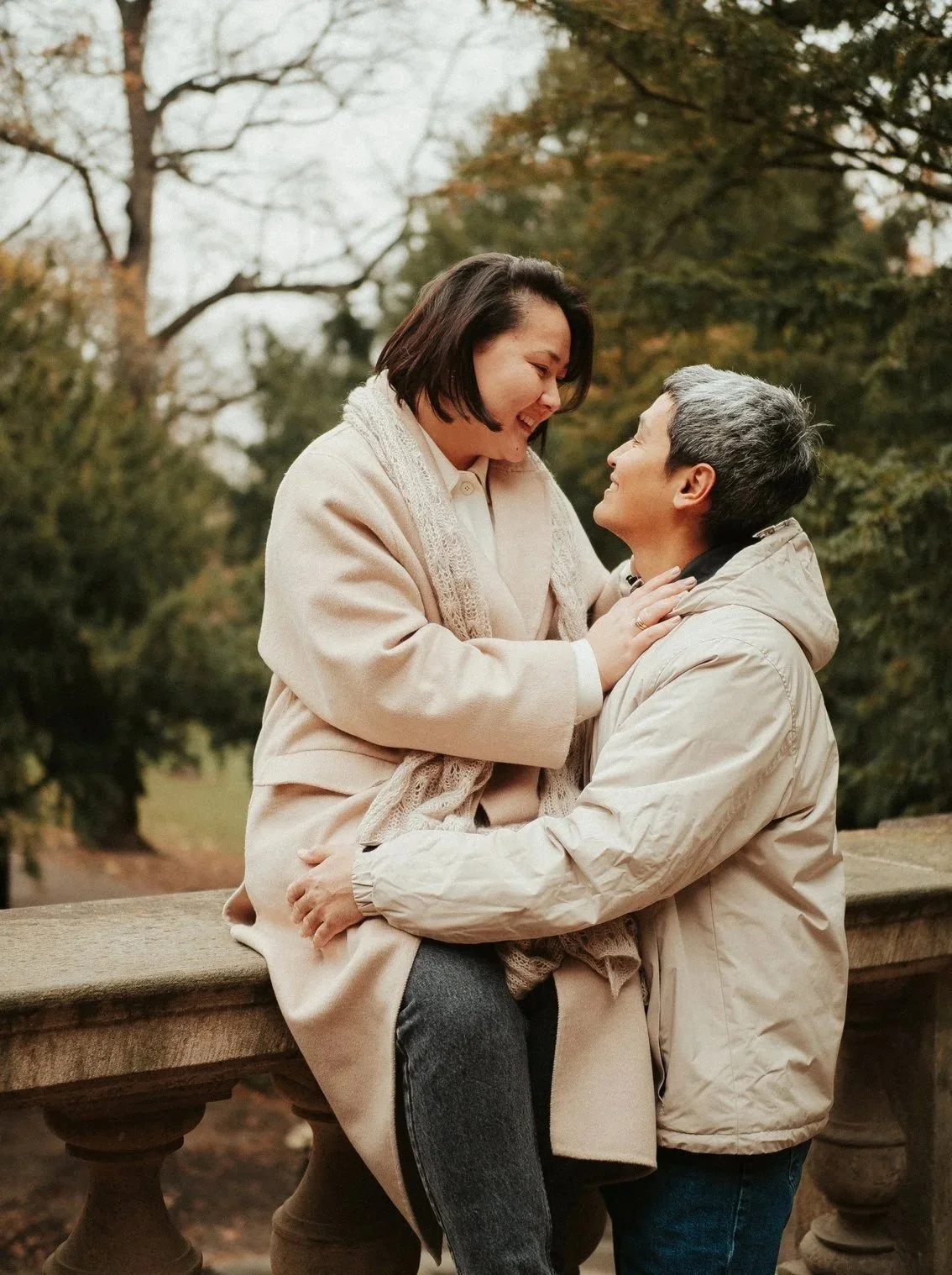
If you've been searching for a therapist in New York who works at the intersection of queer identity and cultural identity, this post is for you. Queer cultural identity therapy in NYC is still a relatively new specialty, and it's one I specialize in, because the tension between these two identities isn't a problem to be solved. It's a specific lived experience that honors multiple parts of you, and the stories they carry and hold on to.
In my Brooklyn practice, I work with queer Asian and Asian American adults, queer immigrants, and LGBTQ+ clients from Central Asian and post-Soviet backgrounds navigating exactly this feeling. What I find most consistently is that the conflict isn't primarily between the person and their family, but between two parts of the person themselves. LGBTQ+ therapy for immigrants and people of color in New York can help you learn how to honor and hold that complexity and let it exist at the same time.
How does the internal/external conflict show up?
For the AAPI (Asian American and Pacific Islander) community
For many queer AAPI adults in New York, coming out can be a departure from the narrative the family built its sense of success and sacrifice around. Depending on how welcoming your family of origin and your community are, it can bring up feelings like self-doubt, guilt, fear, anger, among many others. In the therapy room, we treat your journey as your own: coming out is not the end-all goal, not unless you want it. There is plenty of room in-between for us to focus on what your system needs right now.
The model minority myth assumes a particular kind of life trajectory that is tied to ideas of safety: a stable career, a conventional family structure, children, etc.. For many queer AAPI adults navigating identity in New York and beyond, that means stepping outside a script that carried enormous family meaning, and separating personal values from family narratives
Acceptance isn't the same as being truly known. Whether it is the parent who doesn't object but goes quiet, or the gathering where your partner is introduced as your friend or your roommate, LGBTQ Asian American adults navigate that difference constantly. There can be complex feelings emerging around feeling “tolerated.”
Many queer Asian American adults in NYC find that neither their family world nor their queer community holds the full picture. Each space you enter can feel like there’s a cultural “default” setting, and navigating intergenerational loyalty, language, family of origin dynamics alongside your queerness may not always fit into that default.
The specifics of your experience get lost: while there may be overlaps, no one family is like another. Parts you may feel “lumped” together under the AAPI umbrella, where there is a lot of room and variation in queer identity within people in the community, depending on individual cultural background and circumstances.
The goal of queer cultural identity therapy isn't to choose between your queerness and your Asian American identity, but to find a way to hold both, with more intention and self-compassion, and less self-doubt, guilt, or fear than you’ve been managing on your own.
For Central Asian and post-Soviet communities
If you're reading this as a queer person from Kazakhstan, Kyrgyzstan, Uzbekistan, Tajikistan, or the broader post-Soviet diaspora, I want to name your experiences directly, because almost no therapy content in New York does (or the world, for that matter). We exist, and we always have, and we always will. As a Kazakh queer therapist, I am passionate about providing care to people I am in community with.
The cultural landscape queer Central Asian adults navigate in therapy has no ready-made Western map: the combined influenced of Islam, Soviet-era stigma about mental health, and post-independence nationalism all shape the specific melting pot of feelings you're working with.
In many Central Asian family structures, coming out carries community-wide stakes that most Western queer frameworks don't account for. Many Central Asian people worry about their behavior reflects not just on them but the entire family, impacting their parents’ or siblings’ reputations.
Central Asian cultures vary enormously across countries, generations, and families. It’s important to note that queer Kazakh, Kyrgyz, and Uzbek experiences differ, and this isn't a prediction of how yours will respond.
For queer adults from Muslim-majority Central Asian contexts, the relationship between faith and identity is often more nuanced than Western LGBTQ frameworks suggest, especially when we add in the pagan elements (is that the right word here? correct me if I’m wrong, I’m thinking of smoke cleansing practices and shelpek left for the foregone ancestors - there’s a plethora of cultural and historical practices preceding Islam in the region)
Homosexuality was criminalized across the Soviet Union until the 1990s, and in many post-Soviet families the attitude around queerness is an inherited survival habit, focusing on the perceived dangers and untruths
For Immigrant and first-generation people
If you grew up in an immigrant family, or if you are an immigrant yourself, you know firsthand the constant act of translating yourself, only to over and over learn that inevitably, things and details get lost in the act of translation. Some of the feelings that could be contributing to where you are right now are:
In tight-knit immigrant communities, a family's social standing is collective; for queer first-generation adults in New York, coming out can have real consequences for parents and siblings who had nothing to do with the decision.
Coming out as a queer immigrant is different from coming out in an individualistic context — the stakes are more distributed, and LGBTQ first-generation therapy takes that seriously rather than framing your hesitation as only internalized shame.
Your love for your cultural community isn't the same thing as fear: holding both your queer identity and your genuine affection for your immigrant family world isn't a contradiction to resolve, it's the specific thing you're navigating.
Timing matters and is rarely discussed in queer therapy: coming out during a family immigration process, a parent's illness, or a sibling's engagement carries a lot of context and weight
New York's queer culture has its own defaults that don't always account for immigrant complexity: queer immigrants in New York often find themselves explaining their family situation to people who've never had to make the same calculation.
Therapy for queer immigrants in New York can be a space where your queerness, your cultural identity, your family loyalty, and your grief can all be present at the same time — that kind of spaciousness is rarer than it should be.

If you've been looking for a queer-affirming therapist in New York City who also genuinely understands interdependent family systems, immigrant dynamics, and the specific cultural context you come from as not just a background fact, but a living part of who you are, I'd be happy to hear from you. I offer a free 15-minute consultation for us to see if we would be a good fit. Whether you are AAPI, Central Asian, first-generation, or from any background where queerness and cultural belonging are in tension, this work is something I find genuinely meaningful. You can reach me through the contact form at the link below.
About the Author

Leila Zhanybekova (they/she) is a licensed and board-certified creative arts therapist (LCAT, ATR-BC) with nine years of post-graduate experience providing psychotherapy to adults in NYC. Leila offers virtual EMDR, Internal Family Systems (IFS parts work), and art therapy to immigrants and adult children of immigrants, BIPOC and AAPI communities, LGBTQIA+ and gender diverse people, and high achievers navigating burnout, perfectionism, and complex trauma. Leila works in English and Russian and sees clients across New York State.